
Listen to our podcast
You felt it before you saw it. The other car came in too fast, and now you’re left with a wrecked vehicle, a sore neck, and a story that doesn’t match what the other driver is telling their insurance company. They say they were going the limit. You know they weren’t. So how do you prove it?
Here’s the part most people don’t realize until it’s too late: the evidence that proves speeding starts disappearing within days. Some of it vanishes in as little as 48 hours. That tight window is exactly why knowing what to do next matters so much, and why so many crash victims turn to a New York car accident attorney before that proof gets erased for good.
This guide walks you through the real ways speed gets proven after a crash, what your car already recorded without you knowing, and the brand-new federal rule that’s about to make speed evidence far more detailed than ever before.
Quick Answer: Can You Actually Prove the Other Driver Was Speeding?
Yes, you usually can. Speed gets proven through four main sources: your car’s black box data, accident reconstruction math, nearby camera footage, and vehicle infotainment records. The catch is that most of this evidence is time-sensitive and often requires a formal legal request to obtain, especially when it’s stored in the other driver’s vehicle. Acting quickly is what protects it.
Now let’s break down each piece so you know what you’re working with.
Your Car Already Recorded the Crash: What a Black Box (EDR) Captures
Most drivers have no idea their car keeps a record of what happened right before impact. It does, and it’s called an Event Data Recorder, or EDR.
An EDR is a small module, usually built into the airbag control unit, that automatically saves a short snapshot of what your vehicle was doing around the moment of a collision. Think speed, braking, steering input, accelerator use, engine RPM, seatbelt status, and airbag deployment timing.
Under the current standard, the unit typically captures 15 or more variables. It monitors roughly 20 seconds before the crash and 5 to 10 seconds after, including pre-crash speed, brake application, and the change in speed after impact.
A couple of common myths worth clearing up:
- It’s not a video camera. Most EDRs only store numeric sensor data for a few seconds. They generally don’t keep audio, video, or GPS tracks.
- Almost every recent car has one. EDR data is found in essentially all passenger vehicles built after 2014, though some had them as far back as the 1990s.
So both your car and the other driver’s car likely hold hard numbers about how fast each of you was going. That changes everything about a “he said, she said” dispute.
The 2024 Federal Rule That’s About to Make Speed Evidence Far More Detailed
Here’s something almost no one is talking about yet, and it directly affects future crash cases.
On December 18, 2024, the National Highway Traffic Safety Administration (NHTSA) published a final rule that expands how much pre-crash data an EDR records. The change is big: the recording period for timed data goes from 5 seconds of pre-crash data at 2 Hz to 20 seconds at 10 Hz.
In plain English, black boxes are moving from capturing about 10 data points over 5 seconds to 200 data points over 20 seconds before a crash. That’s a massive jump in detail about speed, braking, and throttle right before impact.
A few timing facts to keep this accurate:
- The rule became effective January 17, 2025, with a compliance date of September 1, 2027.
- In November 2025, NHTSA proposed pushing that compliance date back to September 1, 2028, and adding a phase-in: 25% of a manufacturer’s applicable vehicles starting September 1, 2028, then 50%, 75%, and finally 100% on and after September 1, 2031.
That phase-in is still just a proposal. Public comments were due December 29, 2025, so the rollout timeline isn’t final yet. What this means for you is simple but important: the exact data your specific car records depends on its make, model year, and manufacturer. It’s worth having an attorney or EDR expert confirm what your vehicle actually captured rather than guessing.
For background, NHTSA set up the rules governing EDRs (49 CFR Part 563) back in 2006. It doesn’t force every car to have one. It’s an “if equipped” standard, which keeps the data consistent and requires manufacturers to make a retrieval tool available.
Why the Clock Is Already Ticking: How Fast This Evidence Disappears
This is the part that catches people off guard. The proof of speeding doesn’t sit around waiting for you. It decays, sometimes within hours.
EDR data:
- Many EDRs overwrite their data if another triggering event happens, sometimes after just a few ignition cycles.
- The practical window is days to a couple of weeks. Some systems store only 1 to 3 events, and continued driving can write over the crash data.
- If the car is totaled, it may be moved fast to a salvage or dismantling yard. If it’s destroyed before the data is pulled, that proof can be gone for good.
Camera footage (and this part is very specific to New York City):
- Days 7 to 14: many dashcam recordings get overwritten.
- Days 14 to 30: NYPD body camera and municipal traffic camera recordings may still exist but need formal requests.
- Day 30 and beyond: most businesses have recycled their surveillance footage, and traffic camera data may be purged.
The maximum retention for NYPD body-worn camera footage is 18 months, though footage tied to arrests and major incidents is kept longer. Across systems in general, most traffic cameras hold video for 30 to 90 days, while some private or red-light systems overwrite after just 48 to 72 hours.
That’s the whole reason speed evidence is a race. If you wait, you may simply lose your best proof.
How Experts Prove Speed Without a Black Box
What if a car doesn’t have a working EDR, or you want to back up the numbers? This is where accident reconstruction comes in.
There’s a real formula experts use to estimate minimum speed from skid marks:
Speed = √(30 × distance skidded × drag factor), adjusted for road grade.
A worked example from a technical source: a car skids to a stop on asphalt, leaving four skid marks averaging 60 feet, with a drag factor of 0.75 and 100% braking efficiency. That math produces a calculated speed of 36.7 mph.
Sounds simple enough to do yourself, right? It isn’t, and here’s why:
- Errors creep in fast if the drag factor is measured or estimated wrong, and different road conditions change that factor a lot.
- Finding the drag factor means dragging a weighed tire along the road repeatedly to get an average, plus special equipment and complex formulas.
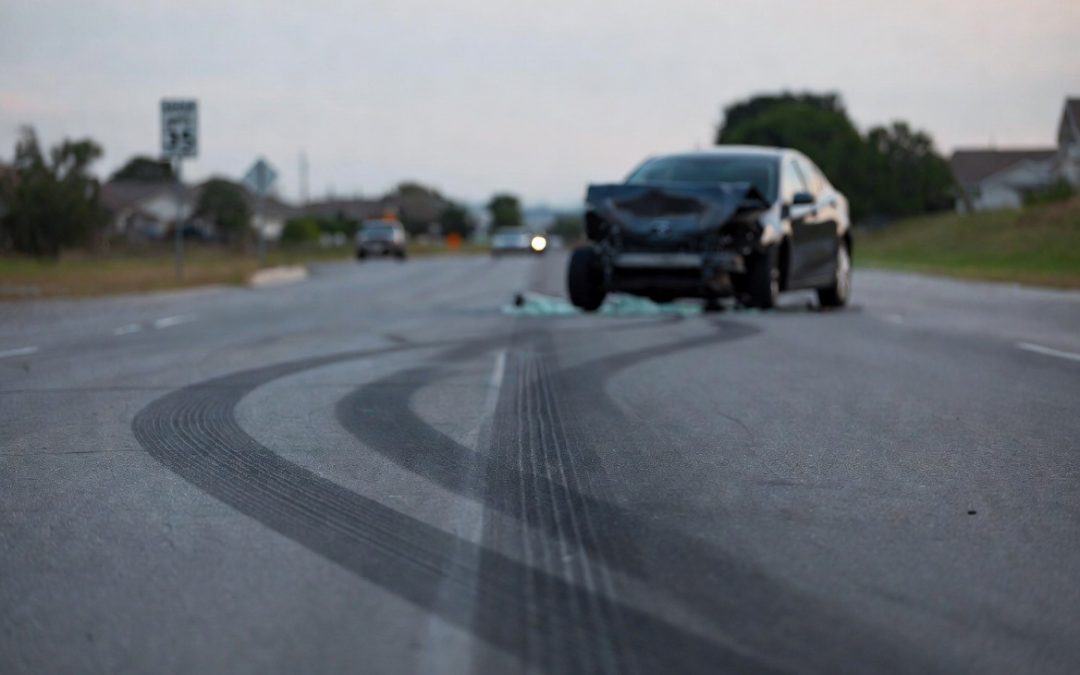
- Modern cars with anti-lock brakes often leave no classic skid marks at all. So reconstructionists also use crush analysis (measuring how much the vehicle deformed) and conservation of momentum from where the cars came to rest. When both vehicles get moved, the standard momentum formula can’t be used, and experts switch to a combined-speed formula based on skid marks and deformation.
The math is real. The problem is that the inputs need equipment and training the average person doesn’t have, and the scene starts changing the second the tow trucks arrive.
Why Speed Evidence Matters So Much in a New York Case
Proving the other driver was speeding isn’t just about being right. In New York, it directly affects how much money you can recover.
New York uses pure comparative negligence under CPLR § 1411. Even if you were partly at fault, you can still recover damages. Your compensation just gets reduced by your share of the fault.
Here’s a concrete example: if you’re 90% at fault in a crash causing $100,000 in damages, you can still recover $10,000 from the other party who was 10% responsible. The New York Court of Appeals confirmed this approach in Rodriguez v. City of New York (2018). Proving the other driver was speeding is exactly how you shift more of that fault percentage onto them, and pull more of it off yourself.
There’s also a threshold question. To seek compensation beyond no-fault coverage, you generally have to file against the at-fault driver and meet the “serious injury” definition under NY Insurance Law § 5102(d). That includes things like death, dismemberment, fractures, significant disfigurement, or permanent limitation of use of a body part or organ. No-fault PIP covers up to $50,000 in basic economic loss regardless of fault, but it does not pay for pain and suffering.
This is where having the right legal team early makes a real difference. We’ve helped many New York and Westchester County clients preserve speed evidence before it disappeared, and if you’re unsure what your case needs, it’s worth speaking with an experienced car accident lawyer in New York while the proof still exists.
The Spoliation Letter: Your Strongest Reason to Act Fast
Here’s a tool most crash victims have never heard of, and it can be the difference between winning and losing.
A spoliation letter is a formal demand that tells the other party (and the manufacturer, salvage shop, or storage yard) to preserve evidence like the EDR. Once it’s sent, destroying or tampering with that evidence can lead to severe court sanctions under New York’s Civil Practice Law and Rules.
The duty to preserve kicks in early. Under VOOM HD Holdings, the obligation is triggered once a party reasonably anticipates litigation, meaning when they’re on notice of a credible probability of being sued.
New York courts set a clear standard for sanctions in Pegasus Aviation I v. Varig Logistica (2015). A party asking for spoliation sanctions must show three things:
- The party who controlled the evidence had a duty to preserve it at the time it was destroyed.
- It was destroyed with a “culpable state of mind.”
- The destroyed evidence was relevant enough that it could have supported the claim.
Intentional or willful destruction is enough to presume relevance, as is destruction from gross negligence. Where the destruction was merely negligent, the party asking for sanctions has to prove relevance.
Why does this matter to you specifically? Because a private individual generally can’t issue a legally enforceable preservation demand or force access to the other driver’s car. That’s a legal lever, and it’s one of the clearest reasons people bring in an attorney quickly.
Getting the Data Out: Access, Admissibility, and Chain of Custody
Knowing the data exists is one thing. Actually getting it and using it in court is another.
Access to the other driver’s vehicle usually requires legal tools. EDR retrieval may need a subpoena or court order if the other party owns the car and won’t allow access. The approach experienced attorneys use includes:
- Sending immediate preservation letters to the owner, manufacturer, salvage shop, and storage yard with the VIN.
- Requesting that the EDR and related modules be preserved and that repairs be suspended.
- Coordinating an early joint inspection or an agreed expert download.
On admissibility: In New York, EDR data is generally admissible in court. But admissibility can depend on proper preservation and extraction, plus authentication by qualified professionals. Courts want the evidence collected correctly, handled carefully, and analyzed by qualified people. It has to show an established chain of custody, use accepted extraction tools, and the side presenting it must show the data wasn’t altered or corrupted from the moment it left the vehicle.
Here’s why all this effort pays off: EDR data is quantitative, which makes it hard for the defense to argue against. In a he-said, she-said situation, hard numbers can shut down the back-and-forth fast.
There’s a bonus source too. Vehicle infotainment systems can capture GPS routes, paired mobile devices, call activity, and telematics. That information can support or challenge distraction claims and add context the crash-only data can’t provide.
The 4 Sources of Speed Proof: A Side-by-Side Look
Here’s how the main evidence types stack up, so you can see what each one offers and how fast it slips away.
|
Evidence Source |
What It Proves |
Typical Survival Window |
How It’s Usually Accessed |
|
EDR / Black Box |
Pre-crash speed, braking, throttle, steering |
Days to a couple of weeks; some overwrite after a few ignition cycles |
Often needs a subpoena or court order for the other car |
|
Accident Reconstruction |
Estimated minimum speed from physical evidence |
Scene-dependent; degrades once vehicles and skid marks clear |
Expert is hired; scene data gathered fast |
|
Camera Footage |
Visual speed and movement before impact |
48–72 hrs (some private) up to 30–90 days; NYPD body cam up to 18 months |
Formal request; footage requests for municipal/police video |
|
Infotainment / Telematics |
GPS, call activity, distraction context |
Varies by system; can be overwritten |
Usually needs legal access to the vehicle |
Notice the pattern. Almost every column points back to speed and time. The strongest proof is also the most fragile.
Why Speeding Cases Are Worth Taking Seriously
A quick look at the national picture shows why these cases carry weight. According to NHTSA’s official 2023 data (released October 2025):
- There were 11,775 fatalities in speeding-related crashes, which was 29% of all traffic deaths that year.
- An estimated 332,598 people were injured in speeding-related crashes, about 14% of all people injured.
- 19% of all drivers involved in fatal crashes were speeding at the time.
- Drivers of passenger cars had the highest speeding rate at 22%, compared to pickups (16%), SUVs (14%), and vans (9%).
There’s a hopeful note for our area too. New York had the second-greatest decrease in traffic fatalities since 1975, down 53%, behind only Massachusetts at 60%. Progress is real, but speeding still drives a huge share of serious crashes.
Frequently Asked Questions
How long does black box data last after a crash? It can be short. Some EDRs overwrite data after just a few ignition cycles, and the practical extraction window is often only days to a couple of weeks. If the car is totaled and sent to salvage, the data can be lost permanently before anyone retrieves it. That’s why early action matters so much.
Can a lawyer get the other driver’s black box data in New York? Often yes, but it usually takes legal tools. If the other party owns the vehicle and won’t grant access, retrieving the EDR may require a subpoena or court order, along with preservation letters to the owner, manufacturer, and any salvage or storage yard.
Is black box data admissible in New York courts? Generally, yes. New York courts typically accept EDR data, but admissibility can depend on proper preservation, extraction by qualified professionals, an established chain of custody, and proof that the data wasn’t altered after it left the vehicle.
Does my car have a black box, and what does it record? If your car was built after 2014, it almost certainly has one, and some date back to the 1990s. It records numeric data like pre-crash speed, braking, accelerator use, steering, and seatbelt status. It does not generally record audio, video, or GPS tracks.
Can I still recover money if I was partly at fault for the crash in New York? Yes. New York follows pure comparative negligence, so you can recover even if you share some blame. Your award is reduced by your percentage of fault. So if you were 10% at fault, your recovery drops by 10%, not to zero.
How long do traffic cameras keep footage in New York City? It varies widely. Most traffic cameras hold video for 30 to 90 days, while some private or red-light systems overwrite footage after just 48 to 72 hours. NYPD body-worn camera footage has a maximum retention of 18 months, with longer retention for arrests and major incidents.
What is a spoliation letter, and why does it matter? It’s a formal notice demanding that a party preserve evidence. Once sent, destroying or tampering with that evidence can lead to serious court sanctions in New York. It’s one of the few ways to legally lock down the other driver’s crash data before it’s gone.
Don’t Let the Proof Disappear: Talk to Someone Who Knows the Clock
The hardest part of proving speed isn’t science. It’s the timing. The black box data, the camera footage, the skid marks, all of it starts fading from the moment the crash ends, and some of it is gone within a couple of days.
At the Law Offices of Norman Gershon, we’ve spent more than 35 years helping injury victims across New York City and Westchester County protect their rights and pursue full compensation. We know how to move fast on preservation letters, coordinate EDR downloads, and turn hard data into a clear picture of what really happened on the road. With the right legal partner acting quickly, you give yourself the best chance to hold a speeding driver accountable.
If another driver’s speed caused your crash, reach out to the Law Offices of Norman Gershon for a conversation about your options while the evidence still exists. The sooner you act, the more proof we can help preserve.
Recent Comments